Introduction
Picture your front desk at 11 PM. A guest walks in with a confirmed booking — but that room was sold on Booking.com two hours ago. Your staff spent the evening updating OTAs manually, but didn't get to that one platform in time.
This is the double-booking gap, and it costs Indian hotels real money, guest trust, and OTA standing. OTAs represented 55% of total online gross bookings in India in 2024, which means most of your reservations are arriving through external platforms that need constant, accurate inventory signals.
This guide breaks down what a PMS and channel manager actually do — and why confusing the two creates operational blind spots that quietly drain revenue. You'll also find practical guidance on choosing the right setup for your property size and distribution goals.
Key Takeaways
- A PMS manages internal operations: reservations, housekeeping, billing, guest profiles, and reporting
- Channel managers handle external distribution — syncing rates and availability across OTAs and booking engines in real time
- Running them without integration creates a gap where double bookings happen and manual errors accumulate
- Expedia's cancellation penalty for a double-booked reservation starts at USD $50 and can reach 50% of the reservation amount, plus a possible 7-day listing suspension
- Whether you need an all-in-one platform or separate integrated tools comes down to your property size, OTA volume, and how complex your operations are
PMS vs Channel Manager: Quick Comparison
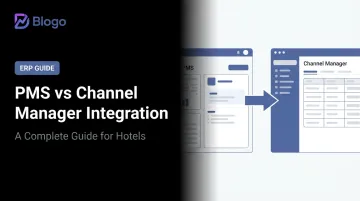
These two tools get confused because both touch reservations and availability — but they operate on opposite sides of the business. A PMS manages what happens inside the property; a channel manager controls how that inventory appears to the outside world.
| Attribute | PMS | Channel Manager |
|---|---|---|
| Primary Function | Manages internal hotel operations | Distributes inventory to external booking platforms |
| Scope | Internal | External |
| Core Users | Front desk, housekeeping, accounts, management | Revenue manager, reservations team |
| Key Features | Reservations calendar, guest profiles, housekeeping status, billing, financial reports | Real-time rate/availability sync, OTA connections, inventory pooling |
| Impact on Revenue | Operational accuracy, cost control, guest retention | Booking volume, rate parity, channel mix optimisation |
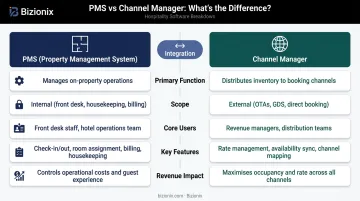
These are complementary tools, not competing alternatives. Every hotel needs both functions covered — whether through separate systems or a single integrated platform.
What Is a Hotel PMS?
A Property Management System is the internal nerve centre for daily hotel operations. Every reservation, guest interaction, housekeeping task, billing transaction, and performance report runs through it. When it works well, your front desk, housekeeping, and finance teams are all working from the same data — no manual cross-checks required.
Core Modules and What They Do
A well-built PMS covers these functional areas:
- Reservation calendar — manages walk-ins, OTA bookings, group blocks, and waitlists from a single view
- Guest profiles and communication — stores preferences, history, loyalty data, and pre-arrival details for consistent service
- Housekeeping status tracking — real-time clean/dirty/inspected updates visible to front desk without phone calls
- Billing and invoicing — auto-posting of room charges, split bills, F&B charges, and audit-ready folios
- Financial reporting — occupancy rates, ADR, RevPAR, daily flash reports, and end-of-day reconciliation
Centralised guest communication matters more than it sounds. When pre-arrival, in-stay, and post-checkout interactions are managed from the same profile, your team isn't starting from zero with every guest. Housekeeping integration directly cuts the coordination delays that slow down same-day check-ins during high-occupancy periods — real-time status updates mean the front desk knows room availability without a single phone call.
Do Small Hotels Actually Need a PMS?
Yes. An Oracle survey of 312 hotel respondents found that 82% of small and medium-sized property owners said upgrading their PMS significantly or dramatically improved revenue performance. The same study showed 31% of independent hotels were still using manual spreadsheets for data reporting — a setup that creates compounding errors at any scale.
Even a 10-room property benefits from centralised reservation management. That 31% still on spreadsheets isn't a small-hotel problem — it's a risk that compounds with every additional booking channel you add.
Bizionix's HotelEase covers all of these modules in a single platform — reservations with OTA integration, front office, housekeeping, billing and POS, guest CRM, analytics, and custom workflows. It's built specifically for small and mid-size Indian hotels, so the configuration matches how these properties actually operate rather than forcing an enterprise template onto a 30-room property.
What Is a Channel Manager?
A channel manager is your external distribution layer. It broadcasts your property's availability and rates to all connected booking platforms simultaneously, eliminating the need to log into each OTA extranet individually to make updates.
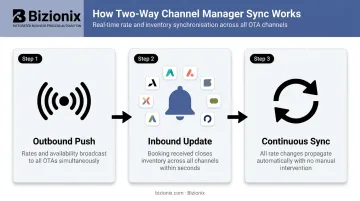
How Two-Way Synchronisation Works
The mechanism is straightforward but the impact is significant:
- Outbound push — Rates and availability are set once and distributed to all connected channels via API simultaneously
- Inbound update — When a booking arrives on any platform, the channel manager immediately closes that inventory across all other channels — within seconds, not hours
- Continuous sync — Any rate change or inventory adjustment propagates across channels automatically, maintaining parity
Which Channels Does It Connect?
For Indian hotels specifically, the most relevant channel types include:
- OTAs — Booking.com, MakeMyTrip, Goibibo, Agoda, Expedia (MakeMyTrip alone sold 37 million hotel room nights in FY25, with 18.9% year-on-year growth)
- GDS — Global Distribution Systems for corporate travel accounts
- Metasearch — Google Hotel Ads, Trivago
- Direct booking engine — the hotel's own website for commission-free reservations
Where a Channel Manager Is Most Valuable
A channel manager has the highest operational impact when:
- Your property is listed on 4+ OTAs and seasonal rate changes need to happen quickly
- You have limited rooms where even one double booking is a serious operational and financial problem
- You're expanding to international OTAs without the admin capacity to manage each manually
The third scenario is where the time cost becomes most visible. A Thailand-based boutique hotel group (Serenata Hotels & Resorts) documented staff spending roughly 15 minutes per OTA update across seven platforms — about 105 minutes per update cycle, per property.
After implementing a channel manager, that dropped to seconds. OTA reach expanded from seven to ten channels, and online revenue doubled within the first year. Independent hotels managing multiple OTAs manually face the same compounding time drain.
Why PMS–Channel Manager Integration Is Non-Negotiable
Running a PMS and channel manager without connecting them creates a specific, costly gap: the PMS records a booking, but the channel manager still shows that room as available until someone manually updates it. That window — which can be hours in a manually operated hotel — is where double bookings happen.
How Two-Way Integration Eliminates Double Bookings
With two-way integration, a reservation on any channel instantly updates inventory across all platforms. The error window shrinks from hours to seconds.
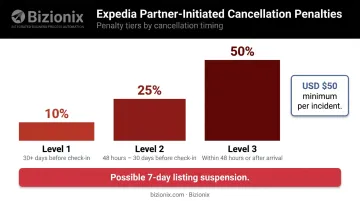
The financial consequences of getting this wrong are concrete. Expedia's Partner-Initiated Cancellation Policy specifies:
- 10% of reservation amount for cancellations more than 30 days before check-in
- 25% for cancellations 48 hours to 30 days before check-in
- 50% for cancellations within 48 hours of check-in or after arrival
- Minimum fee: USD $50 per incident, with no stated maximum
- Possible 7-day listing suspension for partner-initiated cancellations
Beyond financial penalties, Expedia's own data shows properties with a preventable relocation rate above 0.1% have guest experience scores nearly 25% lower than their competitive set — a lasting reputational cost.
Fewer Manual Updates, More Time for Guests
Every rate change you make in the PMS propagates to all OTAs automatically. For a 30-room hotel on five platforms, integration eliminates up to 150 individual manual updates per rate adjustment cycle. Those staff hours redirect to guest service rather than OTA extranet navigation.
Dynamic Pricing Only Works at Integration Speed
Dynamic pricing is structurally impossible to execute manually across multiple channels at the speed markets move. Integration is the infrastructure that makes real-time rate adjustments viable.
This matters especially for Indian hotels. HVS ANAROCK's India Hospitality Overview 2024 shows India closing 2024 with nationwide occupancy of 63–65% and RevPAR 27–29% above pre-COVID levels. March 2026 saw occupancy above 75% across most Indian markets, driven by wedding, MICE, and corporate demand.
Festival seasons, school holidays, and regional events create demand spikes where manually updated rates simply can't keep pace with market conditions.
Centralised Reporting Across All Booking Sources
When integration is working correctly, all bookings — regardless of origin — flow into the PMS. This creates reporting that shows which OTAs deliver the best revenue, lowest cancellation rates, and most valuable guest profiles. Revenue decisions become data-driven rather than intuition-based.
For hotels managing broader business operations — billing, accounting, staff payroll, GST compliance — Bizionix connects HMS data directly with financial and compliance workflows, so billing, GST reporting, and payroll run from the same live data as your reservations. All departments see the same live data: front desk, housekeeping, accounts, and management.
How to Choose the Right PMS–Channel Manager Setup
There's no universal answer here. The right setup depends on your property size, distribution complexity, and how much you want to manage across vendor relationships.
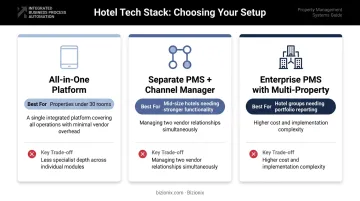
Three Main Setup Options
| Setup | Best For | Key Trade-off |
|---|---|---|
| All-in-one combined platform | Properties under 30 rooms wanting simplicity | Less specialist depth in each area |
| Separate PMS + dedicated channel manager (integrated) | Mid-size hotels needing stronger functionality in each area | Two vendor relationships to manage |
| Enterprise PMS with multi-property channel management | Hotel groups needing portfolio-wide consolidated reporting | Higher cost and implementation complexity |
Key Evaluation Criteria
When assessing any setup, ask these specific questions:
- Sync speed: Real-time updates (within seconds) are the standard — anything slower creates double-booking exposure
- OTA connectivity: For Indian hotels, MakeMyTrip, Goibibo, Booking.com, and Agoda are non-negotiable starting points; confirm all are supported before committing
- Data depth: Does the integration pass guest details and special requests, or only availability signals? Shallow connections mean manual re-entry on the PMS side
- Staff adoption: Measure ease of use during a trial — a simpler system used consistently outperforms a powerful one your team avoids
Situational Recommendations
- Choose an all-in-one if you're a growing small to mid-size Indian hotel wanting to avoid managing two separate vendor relationships and middleware configurations. HotelEase covers this directly — integrated OTA reservations, front office, housekeeping, billing, and reporting in one platform for properties ready to move away from manual chaos
- Choose a dedicated channel manager integrated with your existing PMS if your current PMS is operationally strong but your OTA reach is limited or your rate update volume is high
- Choose an enterprise setup if you manage multiple properties and need consolidated dashboard reporting across locations — something Bizionix's multi-company management supports with separate books of accounts per entity and group-level analytics in a single login
Oracle's 2021 PMS research found that 93% of hoteliers consider technology platform interoperability a key factor for improving hotel performance. Your property size, OTA mix, and operational complexity should drive which of the three setups above makes the most sense.
Frequently Asked Questions
What is the difference between PMS and a channel manager?
A PMS manages internal hotel operations — reservations, housekeeping, billing, and guest communication. A channel manager handles external distribution, syncing your rates and availability across OTAs and booking platforms in real time. They serve different functions but work best when integrated.
What does PMS integration mean?
PMS integration refers to connecting your property management system with other hotel software — such as a channel manager, booking engine, or payment gateway — so they share data automatically. The goal is a unified system where information moves without manual re-entry between platforms.
What is a channel manager for PMS?
It's the integration layer connecting your PMS to external booking platforms. The channel manager pulls availability and rate data from the PMS, distributes it to all connected OTAs, and feeds incoming bookings back into the PMS automatically. Both systems stay in sync without any staff intervention.
What integrations does a channel manager need?
The core integrations are: two-way PMS connection, OTA connections (Booking.com, Expedia, Agoda, MakeMyTrip, Goibibo), GDS for corporate bookings, and the hotel's direct booking engine. A revenue management system integration is optional but valuable for automating dynamic pricing rules.
Do small hotels need both a PMS and a channel manager?
Yes. A PMS handles daily operations while the channel manager prevents double bookings across OTAs. For smaller properties, many all-in-one platforms now combine both functions at a price point accessible to independent hotels — avoiding the need to manage two separate systems.
How does PMS and channel manager integration prevent double bookings?
When a booking arrives on any channel, the integrated system immediately pushes updated inventory to all other platforms, closing availability within seconds. This eliminates the manual update gap where double bookings occur and keeps your room count accurate across all channels in real time.