The problem compounds quickly. Each new branch generates its own records, follows its own processes, and demands constant manual coordination from HQ. Sales reports arrive late. Stock discrepancies go unnoticed. GST invoices get issued incorrectly. With over 5.77 crore registered MSMEs across India's manufacturing, trading, and services sectors, the pressure to scale without losing operational control is acute.
A branch management system solves this by replacing disconnected tools and manual processes with a single platform that gives every stakeholder — from HQ to branch staff — the right information at the right time. This guide covers what these systems are, what problems they fix, which features matter most, the measurable benefits, and a practical five-step implementation approach.
Key Takeaways
- A branch management system is centralised software for managing multiple business locations from one platform
- Eliminates data silos, manual follow-ups, and inconsistent processes across branches
- Core features span a unified dashboard, role-based access, inventory tracking, financial reporting, and GST e-invoicing with IRN generation
- Indian businesses with AATO above ₹5 crore must generate IRNs for B2B invoices — a non-negotiable compliance requirement
- A structured five-step implementation process takes businesses from setup to full optimisation
What Is a Branch Management System?
A branch management system is a centralised digital platform that lets businesses with multiple locations manage operations, finances, inventory, and people from a single interface — rather than juggling separate tools, spreadsheets, or standalone software for each site.
That term covers two things worth separating: branch management as a human function is what a branch manager does — leading a team, hitting targets, resolving local issues. A branch management system is the software that makes that role scalable across five, ten, or fifty locations without the chaos growing proportionally.
Which Businesses Need One
These systems are most valuable for:
- Retailers managing stock, pricing, and billing across multiple outlets
- Franchise networks requiring consistent processes and centralised oversight
- Distribution companies with regional depots handling inter-branch stock movements
- Manufacturers operating across production facilities and warehouses
- Hotel chains and service businesses managing staff, revenue, and compliance across cities
- Business groups with multiple GST-registered legal entities
These segments make up the core of India's MSME landscape — and for most, multi-location growth arrives well before the systems needed to manage it do.
Why Multi-Branch Businesses Struggle Without a Centralised System
The Data Fragmentation Problem
When each branch maintains its own records in separate systems, HQ loses the ability to see the full picture in real time. Sales figures arrive via email, stock counts via WhatsApp. Expense reports land in spreadsheets — each formatted differently.
The result: decisions get made on stale data. A stockout at one branch goes unnoticed while another branch has surplus inventory. A collection that should have triggered a follow-up slips through because nobody had visibility. Financial leakage builds steadily across locations — in ways no one tracks until the damage is done.
APQC's benchmarking data shows that across 2,486 companies, only 60% of recurring finance tasks are automated — meaning the remaining 40% still requires manual intervention. For a multi-branch business, that manual burden is multiplied by every location.
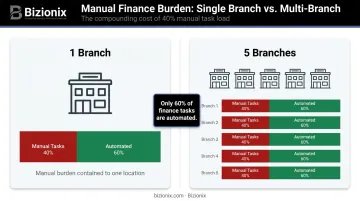
Data fragmentation doesn't stay an operational problem for long — it quickly becomes a compliance one.
Compliance Risk at Scale
Different branches using different invoice formats, applying the wrong GST rates, or issuing invoices without proper IRNs can trigger penalties under CBIC Section 122 — ₹10,000 or the tax evaded, whichever is higher — per offence.
Under GSTN regulations, businesses with AATO exceeding ₹5 crore must report B2B and export invoices to an Invoice Registration Portal for an IRN. Under CBIC Rule 48, an invoice issued without an IRN is not legally treated as an invoice at all. With over 1 lakh small and mid-sized firms flouting e-invoicing norms as of 2023, compliance gaps in multi-branch businesses are a documented, widespread problem — not a theoretical risk.
Compliance pressure, in turn, flows back to HQ — which is already stretched thin managing branches manually.
The Coordination Tax
Every branch expansion adds a coordination burden on HQ. Branch managers spend time fielding calls, compiling reports, and chasing approvals — time that should go toward managing teams and driving revenue. This "coordination tax" is manageable at two locations. At five, approval queues back up, weekly reports take days to compile, and managers spend more time on admin than on the floor.
Key Features of a Branch Management System
Centralised Dashboard and Multi-Branch Visibility
The foundation of any effective branch management system is a single screen that shows HQ what's happening across all locations — sales performance, stock levels, outstanding collections, and team activity — without waiting for someone to compile and send a report.
Bizionix's multi-company management module provides this through a Company Selection Dashboard with group-level analytics and real-time visibility. Users can drill down from a consolidated view to individual branch data, and seamlessly switch between entities without logging out. Each entity maintains independent books of accounts with separate GST, compliance, and financial records — full isolation where needed, consolidated view when required.
Inventory and Stock Management Across Branches
Multi-location inventory management prevents two of the most common operational failures: stockouts at high-demand branches and dead stock sitting idle elsewhere.
A strong system tracks stock levels at each branch in real time, flags replenishment needs automatically, and supports inter-branch transfers with appropriate documentation. For distribution companies and multi-outlet retailers, this is often the single highest-value feature — the ability to see exactly where inventory sits across the entire network and move it efficiently.
Role-Based Access Control and User Permissions
Not every user should see everything. Access needs vary across roles:
- Branch cashier — daily sales records and receipts only
- Branch manager — location-level P&L and team performance
- HQ finance — consolidated view across all branches, without granular operational clutter
Bizionix implements entity-level permissions with role-based controls covering view, edit, and admin levels. Access restrictions can be applied by branch, department, or function, and full activity logs per entity ensure accountability without micromanagement.
Financial Reporting and GST Compliance
Branch-level financial reporting means more than a summary figure. It means P&L statements per location, consolidated balance sheets, audit-ready ledgers, and complete traceability for every transaction.
For Indian businesses, GST compliance is the layer that cannot be treated as optional. Bizionix includes direct API integration with the GST e-Invoice system, generating IRNs instantly at the point of invoice creation. The workflow is fully automated:
- Invoice created in Bizionix
- Data validated automatically against GST rules
- IRN and QR code generated via direct IRP connection
- GST-compliant PDF ready to share with the customer
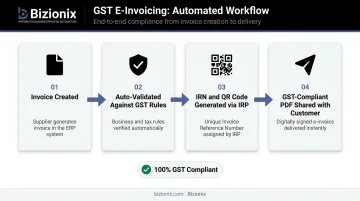
For multi-branch businesses, invoice volumes across locations can be significant. A single compliance failure per branch compounds into serious financial and legal exposure — which is why automated, integrated e-invoicing matters more at scale.
Inter-Branch Communication and Workflow Automation
Without structured workflows, branch coordination defaults to informal channels — WhatsApp groups, forwarded emails, verbal instructions. These create ambiguity, delay accountability, and leave no audit trail.
A branch management system standardises approval flows, purchase order processing, and task assignments so that every branch follows the same documented process. Bizionix's Document Workflows module enforces digital approval chains, ensuring that employees follow defined processes rather than improvising their own. The result is consistent execution across branches — and far less exposure when a key branch manager is unavailable or replaced.
Business Benefits of a Branch Management System
Improved Operational Efficiency
Automating stock updates, invoice generation, and report compilation frees branch staff from administrative tasks and redirects their time toward customer-facing work. The efficiency gains can be significant. A Forrester Consulting study commissioned for Microsoft Dynamics 365 Business Central found up to 50% finance productivity improvement and 30% faster financial close for a composite organisation — a directional benchmark, not a guarantee, but indicative of the scale of change possible.
Real-Time Decision Making
The shift from monthly reporting to real-time visibility changes how HQ manages branches. Instead of discovering at the end of the month that one branch had a collection shortfall, or that stock ran out during a peak period, managers can see and act on issues as they develop.
Real-time dashboards give central teams the visibility to intervene early — before a stock-out affects sales or a collection delay compounds into a cash flow problem.
Cost Reduction and Scalability
Running separate accounting software, inventory apps, and communication tools for each branch creates overlapping licensing costs, constant data re-entry, and mounting IT maintenance overhead. Consolidating onto a single platform eliminates most of this.
Scaling is also far simpler. Adding a new branch to a centralised system means configuring the entity, defining user roles, and loading master data — not rebuilding anything from scratch. A business can grow from three branches to fifteen without a proportional increase in back-office headcount or management complexity.
Standardisation Across Locations
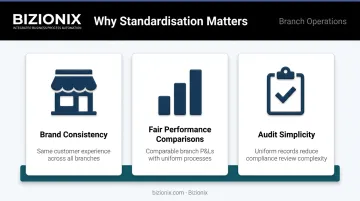
Centralised configuration means every branch uses the same pricing structure, billing format, approval workflows, and compliance processes. This matters for three reasons:
- Brand consistency — customers get the same experience regardless of which branch they visit
- Fair performance comparisons — branch P&Ls are comparable when processes are standardised
- Audit simplicity — compliance reviews become far less painful when records are uniform across locations
How to Implement a Branch Management System: A Step-by-Step Guide
Gartner notes that by 2027, more than 70% of recently implemented ERP initiatives will fail to fully meet their original business case goals — with weak goal alignment, low user adoption, and data integrity failures as the leading causes. A structured implementation approach directly addresses each of these risks.
Step 1 — Audit Your Current Operations and Define Requirements
Before selecting any platform, map how each branch currently operates. Document what data each location generates, which processes vary between branches, and what visibility HQ currently lacks. This assessment shapes system configuration and prevents the common failure of forcing a generic tool onto a specific business model.
Key questions to answer:
- Which branches have the most inconsistent processes?
- Where does data currently get lost or delayed?
- What GST compliance gaps exist across locations?
- What does each role actually need to see and do in the system?
Step 2 — Select the Right Platform for Your Business Type and Scale
Evaluate platforms against these criteria:
| Criterion | What to Look For |
|---|---|
| Architecture | Cloud-based for accessibility across branch locations |
| GST Compliance | Direct IRP integration, automated IRN generation |
| Scalability | Ability to add branches without rebuilding |
| Usability | Accessible to non-technical branch staff |
| Multi-entity support | Single login, consolidated and separate views |
| Vendor support | Implementation help, not just software |
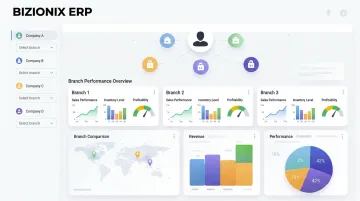
Bizionix is built specifically for this use case — a cloud ERP designed for Indian MSMEs that offers enterprise-grade multi-branch management without SAP-level complexity or cost. The ability to manage multiple entities under a single secure login, maintain independent books per branch, and generate IRNs instantly makes it a practical fit for growing businesses navigating both operational and compliance requirements.
Step 3 — Configure the System and Migrate Existing Data
Configuration involves setting up branch profiles, defining user roles and permissions, loading product and inventory master data, and mapping existing financial accounts. Data quality at this stage determines the reliability of everything that follows — clean input data produces trustworthy reports; messy data produces noise.
Prioritise migrating:
- Customer and vendor master records
- Opening stock balances per branch
- Outstanding receivables and payables
- Chart of accounts
Step 4 — Train Branch Teams and Establish SOPs
Technology adoption fails when training is treated as a one-time event. Role-specific training outperforms generic sessions: HQ admins need to understand consolidated reporting and user management; branch managers need to master daily operations and approvals; operational staff need to handle their specific workflows without escalations.
Alongside training, document standard operating procedures for common workflows — how to raise a purchase order, process a customer invoice, or initiate an inter-branch stock request. A feedback loop during the first four to six weeks catches usability issues before they become entrenched habits.
Step 5 — Monitor, Measure, and Optimise Post-Go-Live
Set branch-level KPIs before go-live — sales targets, collection cycle benchmarks, inventory turnover thresholds. Use the dashboard to track performance against these benchmarks weekly rather than waiting for month-end reports.
Run a structured review at the 60-90 day mark to identify configuration adjustments, address adoption gaps, and confirm the system is actively informing decisions. At this point, success means the system is shaping daily decisions — not just recording them.
Frequently Asked Questions
What is branch management?
Branch management refers to overseeing the operations, staff, finances, and performance of individual business locations within a larger organisation. It covers both the human leadership function — what a branch manager does daily — and the software systems that make that oversight scalable across multiple locations.
What is a branch banking system?
A branch banking system refers to the network structure and management tools used by banks or financial institutions to operate multiple branch offices. For non-banking businesses, the equivalent is a multi-branch ERP or branch management system that handles operations, inventory, and financial reporting across locations.
How is a branch management system different from a regular ERP?
A standard ERP manages core business functions for a single entity. A branch management system extends this with multi-location architecture: consolidated reporting, role-based access controls per branch, branch-level P&L tracking, and inter-branch transaction handling that single-entity ERPs don't support.
Can small businesses with just 2-3 branches benefit from a branch management system?
Yes. Manual coordination between even two branches is time-consuming and error-prone. Cloud-based systems like Bizionix are affordable for smaller multi-location businesses and scale as new branches are added.
What are the most important features to look for in a branch management system?
Key features to prioritise: real-time centralised dashboard, role-based access controls, cross-location inventory tracking, branch-level financial reporting, and GST compliance tools. Indian businesses should also confirm direct IRN generation support, which is mandatory above the ₹5 crore AATO threshold.
How does a branch management system help with GST compliance across multiple locations?
A GST-ready system ensures each branch generates properly structured tax invoices, validates data before IRP submission, generates IRNs automatically, and maintains audit-ready records. This eliminates the compliance risk that multiplies with each additional branch, since a single invoice error can attract penalties of ₹10,000 or the tax evaded, whichever is higher.