Introduction
India's MSME export sector has grown at a pace that would have seemed ambitious just five years ago. According to a PIB release from December 2024, the number of exporting MSMEs jumped from 52,849 in 2020-21 to 1,73,350 in 2024-25 — with MSME export value rising from ₹3.95 lakh crore to ₹12.39 lakh crore in the same period. MSMEs now contribute nearly 45.73% of India's total exports.
That growth comes with serious compliance weight. Export businesses must manage zero-rated GST invoicing, LUT filings, IGST refund tracking, and multi-currency reconciliation. Businesses above ₹5 crore aggregate turnover also face mandatory e-invoicing with IRN generation.
Generic accounting software handles none of this cleanly. A tool built for domestic billing won't distinguish between export-with-IGST and export-under-LUT, won't map invoices to GSTR-1 Table 6A, and won't flag mismatches that delay refunds.
This guide covers the five best accounting software options for Indian export businesses in 2024, evaluated specifically for GST export compliance, multi-currency support, and MSME scalability.
Key Takeaways
- Indian exporters need software that handles zero-rated GST, LUT vs. IGST-paid export routes, e-invoicing with IRN, and GSTR-1 Table 6A — not just basic bookkeeping
- The e-invoicing threshold has been ₹5 crore since 1 August 2023 — any exporter above this must generate IRN for export transactions
- Top picks: Bizionix (multi-entity ERP), Zoho Books (GST-first), Tally Prime (desktop GST), QuickBooks (multi-currency), Xero (forex + export docs)
- India-built tools (Bizionix, Zoho, Tally) have stronger verified GST compliance depth than global platforms
- Pick for compliance fit first; scalability and cost come second
Why Indian Export Businesses Need Specialized Accounting Software
The Compliance Layer Generic Tools Miss
Export accounting in India isn't just accounting with a currency toggle. Under Section 16 of the IGST Act, exports qualify as zero-rated supplies — but exporters have two distinct routes:
- Export under LUT/bond (FORM GST RFD-11, Rule 96A): No IGST paid upfront; claim refund of unutilised ITC
- Export with IGST payment: Pay integrated tax and claim cash refund
These two routes generate different voucher types, different GSTR-1 entries, and different refund documentation requirements. Software that doesn't separate them creates reconciliation errors that follow a business all the way to refund processing.
Where Things Go Wrong Without the Right Software
Each of these failure points has a direct cost — delayed refunds, deficiency memos, or rejected returns. Exporters without purpose-built tools typically run into:
- Manual forex reconciliation — converting foreign currency receipts to INR across multiple invoices, often in spreadsheets
- GSTR-1 Table 6A errors — export invoices not correctly mapped, causing auto-population failures and return mismatches
- Refund delays — CBIC Circular 125/44/2019-GST allows 90% provisional refund for zero-rated supplies, but requires complete GSTR-1 and GSTR-3B filing; any mismatch between the GST invoice and shipping bill triggers a deficiency memo
- E-invoicing gaps — exporters above ₹5 crore turnover must generate IRN for export invoices (EXPWP and EXPWOP supply types), and missing this creates compliance risk
- Multi-entity confusion — business groups with multiple export entities managing separate books across disconnected tools
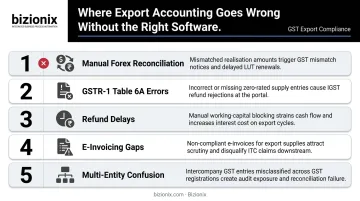
Addressing these gaps requires software that manages LUT tracking, forex conversion, and IRN generation within a single workflow — not patched together through spreadsheets and manual filing.
Best Accounting Software for Export Businesses in 2025
Evaluated on: India-specific GST compliance, multi-currency support, e-invoicing capability, scalability for MSMEs, and real-world export usability.
Bizionix
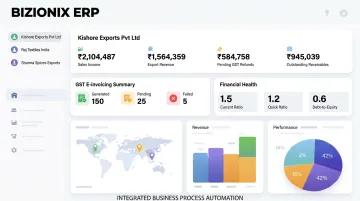
Bizionix, developed by IIS-LLP (a subsidiary of Protocol India Private Limited), is a 100% cloud-based ERP built specifically for Indian MSMEs. It combines accounting, GST e-invoicing, inventory, warehouse management, and multi-company operations into a single unified platform, backed by over two decades of industry experience.
The platform's direct API integration with the GST Invoice Registration Portal enables instant IRN generation without third-party tools.
For export businesses managing multiple entities — separate GST registrations, product lines, or regional operations — multi-company management under a single login keeps operations consolidated. Each entity maintains independent books, GST records, and compliance filings, while group-level dashboards provide consolidated oversight.
| Feature Area | Details |
|---|---|
| Key Features | GST-ready accounting, automated e-invoicing with IRN generation, multi-company management, inventory and warehouse management, real-time financial dashboards, HRMS, CRM, cloud access |
| Compliance & Export Suitability | Built for Indian GST compliance; direct API integration with IRP eliminates manual IRN filing; GSTR-1 auto-population; designed for Indian GST regulations including e-Invoice, e-Way Bill, GSTR filings |
| Pricing / Best For | NEO plan at ₹999/year (14-day free trial); Enterprise plan with custom pricing; best for growing exporters managing multiple entities or product lines who need a scalable, unified ERP |
Zoho Books
Zoho Books is a cloud-based accounting platform developed by Zoho Corporation in India, widely adopted by Indian SMEs for its balance of GST depth, affordability, and ecosystem breadth. For exporters, it's one of the strongest options in the mid-market segment.
The platform supports GST-compliant export invoicing, handles zero-rated exports, and connects to the Invoice Registration Portal directly, allowing users to register Zoho Corporation as their GST Suvidha Provider for e-invoicing. Its GSTR-1 filing workflow includes an EXP section filter for export invoice reconciliation. Multi-currency transactions are available from the Professional plan upward.
| Feature Area | Details |
|---|---|
| Key Features | Multi-currency invoicing, GST return filing, bank reconciliation, inventory tracking, automated workflows, client portal, mobile app |
| Compliance & Export Suitability | Supports GST-compliant export invoices; IGST and zero-rated export handling; e-invoicing with IRP connection; Skydo integration for forex payment reconciliation |
| Pricing / Best For | Free plan for businesses under ₹25L turnover; paid plans from ₹749/org/month (billed annually) for 3 users; best for small to mid-sized Indian exporters needing affordable GST-compliant accounting |
Tally Prime
Tally Prime is India's most widely deployed accounting and ERP software, trusted by businesses and CA firms for decades. Its GST compliance engine is deep and export-aware — it supports export voucher types, LUT/bond-based entries, and GSTR-1 Table 6A mapping natively.
In TallyPrime, recording a sale under LUT/bond requires selecting "Export under LUT/Bond" as the nature of transaction, and the system automatically routes it to the GSTR-1 export table. It also handles Exports Taxable, Exports Exempt, and Exports Nil Rated categories within GSTR-1 reporting.
The primary limitation for distributed export teams is its desktop-first architecture. While TallyPrime 4.0 introduced some remote access capabilities, it's less suited to cloud-native, multi-location operations.
| Feature Area | Details |
|---|---|
| Key Features | GST invoicing and filing, export voucher types, inventory management, payroll, multi-currency ledger, bank reconciliation, audit trail |
| Compliance & Export Suitability | Strong LUT/bond and IGST-paid export entries; GSTR-1 Table 6A mapping; widely accepted by CA firms; enables nearly 2.5 million businesses worldwide |
| Pricing / Best For | TallyPrime Silver: ₹18,000/year (single user); Gold: ₹54,000/year (multi-user); best for established Indian exporters who prefer desktop-based accounting with deep GST capability |
Note: Verify current pricing on Tally's official website before purchase.
QuickBooks Online
QuickBooks Online by Intuit is a globally recognised cloud accounting platform with a documented workflow for export GST sales invoices in India, including a GSTR1-6 Exports report. Its strengths are a clean interface, strong bank synchronisation, and a wide integration ecosystem with payment processors and CRMs.
For Indian exporters billing international clients in USD or EUR, its multi-currency capability is functional, though it must be enabled separately. The practical caveat: QuickBooks' India-specific GST compliance depth, particularly around GSTR-1 automation and e-invoicing, is less comprehensively verified compared to India-first tools. Exporters with heavy GSTR filing requirements should validate current India features directly with Intuit before committing.
| Feature Area | Details |
|---|---|
| Key Features | Multi-currency invoicing, bank reconciliation, expense tracking, inventory management, customisable reports, third-party app integrations |
| Compliance & Export Suitability | Supports GST invoicing for India; multi-currency for foreign client billing; GSTR-1 Exports report documented; current e-invoicing and GSTR automation should be verified with Intuit |
| Pricing / Best For | Check current India pricing at QuickBooks India website; best for tech-savvy exporters comfortable with a global platform who prioritise integrations and multi-currency billing |
Xero
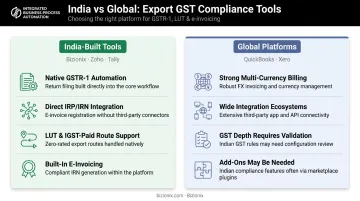
Xero is a New Zealand-based cloud accounting platform with genuine strengths for exporters managing international client relationships. Its multi-currency accounting automates real-time currency conversions, and its integration with IncoDocs — a purpose-built export documentation platform — lets businesses manage shipping documents directly within their accounting workflow.
The honest limitation for Indian exporters: Xero's native India GST filing and GSTR support has not been independently verified from official India product pages. Exporters with substantive GSTR-1 filing requirements or e-invoicing mandates will likely need third-party add-ons to close that gap.
| Feature Area | Details |
|---|---|
| Key Features | Multi-currency accounting, automated bank reconciliation, cloud access, inventory tracking, invoicing, 1,000+ app integrations including IncoDocs for export docs |
| Compliance & Export Suitability | Strong multi-currency forex handling; IncoDocs integration for export documentation; India GST/GSTR filing requires validation with add-ons |
| Pricing / Best For | Check current India pricing at Xero's website; best for export businesses with international client bases that prioritise multi-currency management and third-party integrations over local GST depth |
What to Look for When Choosing Accounting Software for Your Export Business
Not all accounting software is built for exporters — and the gap shows up fast. Before evaluating specific platforms, it helps to know what separates a genuinely export-ready tool from one that just looks the part.
The Most Common Mistake
Most exporters choose software based on brand reputation or global user counts, then discover it can't generate zero-rated export invoices, tag LUT entries, or populate GSTR-1 Table 6A correctly. The result: more manual work, not less.
Critical Evaluation Factors
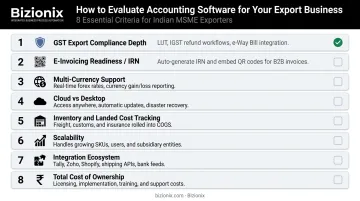
Before signing up for any platform, evaluate these specifically:
- GST export compliance depth — Does it handle both LUT/bond and IGST-paid export routes? Does it map to GSTR-1 Table 6A automatically?
- E-invoicing readiness — Does it connect directly to the IRP for IRN generation? (Required for exporters above ₹5 crore aggregate turnover since 1 August 2023)
- Multi-currency support — Can it raise invoices in USD, EUR, GBP and record INR equivalents automatically?
- Cloud vs. desktop — Cloud access matters for distributed teams; desktop tools like Tally remain viable for single-location operations with offline reliability requirements
- Inventory and landed cost tracking — Relevant for goods exporters managing warehouse stock and shipment-level costs
- Scalability — Can the platform grow with your export volumes, new product lines, or additional entity registrations?
- Integration with existing tools — Banking platforms, CRM, shipping, or forex payment platforms
- Total cost of ownership — License fees plus implementation, training, and ongoing support
Match the Tool to the Operation
Once you know what to evaluate, matching the tool to your operation becomes straightforward. The right choice depends on your entity structure, GST complexity, and growth trajectory:
- Single-entity exporters with straightforward invoicing → Zoho Books or QuickBooks
- Established exporters needing deep GST capability → Tally Prime
- Growing exporters managing multiple entities or product lines → an ERP built for Indian MSMEs, like Bizionix, which handles multi-entity GST filing and direct IRP integration from a single login
- Export businesses billing primarily international clients → Xero or QuickBooks for multi-currency depth
Conclusion
The right accounting software for an Indian export business handles more than double-entry bookkeeping. It needs to manage zero-rated GST invoicing across two distinct export routes, generate IRNs for e-invoicing compliance, reconcile foreign currency receipts in INR, populate GSTR-1 export tables correctly, and support the IGST refund documentation that directly affects working capital.
India-built tools — Bizionix, Zoho Books, and Tally Prime — hold an evidence-based edge on GST compliance depth. Global platforms like Xero and QuickBooks bring multi-currency and integration strengths, but require careful validation of their India GST capabilities before deployment.
When shortlisting, your decision should account for:
- GST compliance depth: Zero-rated invoicing, IRN generation, and GSTR-1 export table accuracy
- Foreign currency handling: INR reconciliation and multi-currency ledger support
- IGST refund readiness: Documentation workflows that protect working capital
- Scale fit: Whether standalone accounting or a unified ERP better suits your shipment volumes and entity structure
For exporters managing multiple entities, high shipment volumes, or complex inventory across warehouses, accounting software alone may not be enough. An ERP that unifies compliance, operations, and financial reporting under one system closes the reconciliation gaps that cause refund delays and audit risk.
Bizionix by IIS-LLP is built for that scenario — combining GST-ready accounting, e-invoicing, inventory, and multi-entity management in a single platform designed for Indian MSMEs. Contact the team at info@bizionix.com or +91 91779 99277 to explore whether it fits your export operation.
Frequently Asked Questions
What is the best accounting software for an export business?
There's no single answer — it depends on your business size, GST compliance needs, and whether you require full ERP capabilities or just accounting. India-built tools like Bizionix and Zoho Books have a clear edge for GST compliance depth, while Xero and QuickBooks suit exporters whose priority is multi-currency billing for international clients.
Does export accounting software need to support GST compliance in India?
Yes. Indian export businesses must generate GST-compliant invoices (zero-rated, with or without IGST payment) and file GSTR-1 with export data in Table 6A. Software that doesn't handle these natively creates manual compliance work and refund delay risk. E-invoicing requirements for exporters above ₹5 crore turnover are covered in the final question below.
What is multi-currency support and why does it matter for exporters?
Multi-currency support lets exporters raise invoices in foreign currencies like USD, EUR, or GBP, then automatically convert and record the INR equivalent at the applicable exchange rate. Without it, forex receipt reconciliation becomes a manual, error-prone process that distorts financial reporting.
What is the difference between accounting software and ERP for export businesses?
Accounting software handles financial records, invoicing, and tax compliance. ERP integrates all of that with inventory, order management, warehousing, purchasing, and HR in a single system. Larger exporters, or those managing multiple product lines and entities, typically outgrow standalone accounting tools and benefit more from an ERP like Bizionix.
Is cloud-based accounting software better than desktop software for export businesses?
Cloud-based software offers remote access for distributed teams, real-time financial visibility, and automatic compliance updates, making it the better fit for most growing export businesses. Desktop tools like Tally remain a solid choice for single-location operations that rely on offline reliability and a trusted CA firm.
How does e-invoicing apply to Indian export businesses?
Indian businesses above ₹5 crore aggregate turnover must generate e-invoices with IRN from the GST portal for all B2B and export transactions, including EXPWP and EXPWOP supply types (per CBIC Notification 10/2023-Central Tax, effective August 2023). Software with direct IRP API integration automates IRN generation and removes the risk of manual filing errors.