Without a connected hotel POS system, properties fall back on manual reconciliation, handwritten charge slips, and the billing errors that follow. Revenue leaks. Checkout takes longer. GST reporting becomes a weekend headache.
This guide covers what hotel POS software actually does, the features that matter most for Indian operations, and the top five systems worth evaluating in 2025.
Key Takeaways
- Hotel POS software processes transactions across all revenue centres (restaurant, bar, spa, retail) and consolidates them into a single guest folio.
- Deep PMS integration, GST-compliant billing, and real-time reporting are non-negotiable features.
- Cloud-based systems are preferred for scalability, remote access, and easier updates.
- Must-have features include mobile POS, multi-outlet management, and inventory tracking.
- Top five systems for Indian hotels: Oracle MICROS Simphony, eZee BurrP!, Lightspeed Restaurant, Hotelogix POS, and IDS Next FortuneNEXT.
What Is Hotel POS Software and Why Does It Matter?
A hotel POS system is the combination of hardware and software that processes guest transactions across every on-property revenue centre — restaurants, bars, spas, gift shops, and room service — and consolidates all charges into a single invoice at checkout.
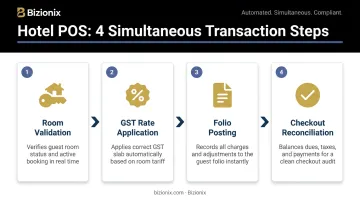
That last part is what separates a hotel POS from a generic retail terminal. A retail POS closes a sale and moves on. A hotel POS has to do four things simultaneously:
- Validate the guest's room number before posting
- Apply the correct GST rate for that specific service category
- Post the charge automatically to the right folio
- Ensure the total reconciles accurately at checkout
The global hotel and hospitality management software market is projected to grow by USD 2.98 billion at a 10.9% CAGR during 2023–2028, per Technavio — a signal that technology investment in this space is accelerating worldwide. For Indian hotels specifically, where GST compliance, UPI payments, and multi-outlet operations add layers of complexity, choosing the wrong POS creates compounding errors that show up at checkout — and in your compliance filings.
Must-Have Features and Integrations in a Hotel POS System
PMS and ERP Integration
Deep, real-time integration with a Property Management System is the single most critical feature in any hotel POS. The POS should:
- Validate guest room numbers before posting charges
- Auto-post transactions to the correct folio without manual entry
- Produce a single consolidated invoice at checkout
Manual charge posting creates two problems: data entry errors and delayed billing. When a guest disputes a charge at 11pm during checkout, a disconnected system means digging through paper records.
Hotels using a broader ERP platform benefit even more. Bizionix HotelEase, for instance, includes a native Billing & POS module that connects auto-posting, split bills, room charges, and F&B transactions directly to the accounting system. Every outlet charge flows into financial records in real time, with no separate reconciliation step required.
GST-Compliant Billing and Payment Flexibility
Indian hotels face a layered GST structure that the POS must handle automatically:
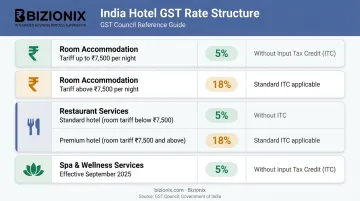
- Room accommodation up to ₹7,500 per night: 5% (without ITC), as updated per the 56th GST Council recommendations effective 22 September 2025
- Room accommodation above ₹7,500: 18%
- Restaurant service (standard): 5% without ITC; restaurants in hotels where room tariff is ₹7,500 or above: 18% with ITC
- Spa/wellness services: reduced to 5% without ITC from 22 September 2025
For hotels with annual aggregate turnover exceeding ₹5 crore, e-invoicing with automated IRN generation is mandatory under Notification 10/2023-Central Tax. The POS must support this without manual intervention.
On payments, the system should accept all of the following without exception:
- Credit and debit cards
- UPI and digital wallets
- Cash
- Room-charge billing to guest folio
Inventory and Menu Management
Without real-time stock tracking, hotels face two recurring losses: serving an item that's already out of stock, and over-ordering because no one has an accurate picture of what's in the storeroom.
A well-configured hotel POS should:
- Track stock across restaurant, bar, mini-bar, and spa retail simultaneously
- Trigger alerts when items fall below threshold levels
- Allow instant menu updates — price changes, seasonal additions, outlet-specific modifiers — without IT involvement
Generic retail POS tools don't support ingredient-level tracking — a gap that directly affects F&B cost control. Hospitality-specific systems calculate consumption per recipe, so a variance between theoretical and actual usage flags a problem before it compounds.
Mobile Capabilities and Multi-Outlet Management
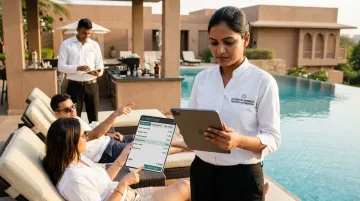
Fixed POS terminals have an obvious limitation: they don't work poolside. Mobile POS functionality allows staff to take orders on tablets or smartphones during outdoor dining, spa bookings, or banquet events — without forcing guests to a terminal.
Mobile capability solves the access problem. Multi-outlet management solves a different one: visibility. A property running a restaurant, bar, and spa needs:
- Unified revenue reporting across all outlets
- Outlet-level accountability (separate P&L per centre)
- A single dashboard, not three disconnected systems
For resort hotels with five or more revenue centres, a fragmented dashboard means managers are always a step behind — chasing data rather than acting on it.
Real-Time Reporting and Analytics
Managers who can't see revenue by outlet, identify peak sales windows, or track staff performance are making decisions without data. That gap shows up in margins.
A capable hotel POS delivers:
- Revenue breakdown by outlet and item category
- Daily sales summaries and trend comparisons
- Staff performance and shift-level reports
- Inventory consumption linked to revenue
Hotelogix, for instance, provides over 100 report types within its POS module, covering daily operations, inventory, and financials from a single dashboard.
Top 5 Hotel POS Systems for Indian Hotels
Each system below was evaluated on five criteria:
- Hospitality-specific functionality for F&B and front-desk operations
- PMS/ERP integration depth
- GST compliance and Indian statutory readiness
- Scalability for mid-size to large properties
- Quality of regional support
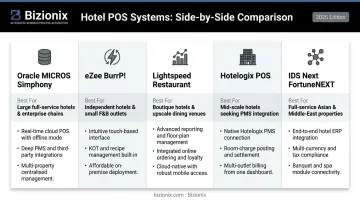
Oracle MICROS Simphony
Oracle MICROS Simphony is an enterprise-grade, cloud-based hospitality POS used by major hotel chains globally. Five-star properties and multi-outlet hospitality groups rely on it globally, and it integrates deeply with Oracle Hospitality Opera PMS.
A single system controls F&B operations across dozens of outlets, with advanced analytics and kitchen display integration rounding out the capability set.
| Category | Details |
|---|---|
| Best For | Large hotel chains, multi-property groups, luxury resorts with complex F&B operations |
| Key Features | Cloud-based multi-outlet management, real-time PMS sync with Oracle Opera, kitchen display integration, advanced reporting |
| Pricing | Custom enterprise quote; hardware costs are separate. Contact Oracle Hospitality for pricing. |
eZee BurrP!
eZee BurrP! is an India-origin hospitality POS from eZee Technosys, designed specifically for restaurant and hotel F&B operations. It's widely adopted across mid-size Indian hotels, independent resorts, and regional chains.
Key advantages for Indian properties: strong integration with eZee Absolute PMS, GST-compliant billing native to the platform, and local support across India. Capterra lists an indicative starting price of approximately ₹575 per user (one-time), though eZee's official pricing is requirement-based — contact them for a quote.
| Category | Details |
|---|---|
| Best For | Mid-size Indian hotels, independent properties, and chains wanting an India-built solution |
| Key Features | GST-compliant billing, eZee Absolute PMS integration, multi-outlet support, table management, inventory tracking |
| Pricing | Requirement-based quote; indicative starting price ~₹575/user (one-time) per Capterra |
Lightspeed Restaurant
Lightspeed Restaurant is a cloud-based POS platform used globally by restaurants and hotel F&B outlets. Its standout capability is ingredient-level inventory tracking — useful for high-volume hotel restaurants where cost control and recipe consistency matter.
It integrates with Oracle Hospitality Opera, Mews, and StayNTouch, making it compatible with several PMS platforms common in Indian hotel operations. Hardware is purchased separately through Lightspeed's sales team or online store. India-specific pricing should be confirmed with Lightspeed directly.
| Category | Details |
|---|---|
| Best For | Hotels with high-volume restaurants and bars requiring detailed cost-and-profit tracking |
| Key Features | Ingredient-level inventory tracking, recipe costing, multi-location dashboard, real-time stock alerts, PMS API integration |
| Pricing | Tiered monthly subscription (Starter, Essential, Premium, Enterprise); hardware separate. Confirm India pricing with Lightspeed sales. |
Hotelogix POS
Hotelogix is an India-based cloud hotel management platform with a built-in POS module designed for small to mid-sized hotels and resorts. Because the POS and front-desk management operate from the same platform, there's no separate PMS integration to configure — which reduces both complexity and cost.
The system is GST-compliant and connects to MyGSTcafe for e-invoicing and return filing. It provides over 100 report types and supports restaurant, minibar, spa, and travel desk management from a single dashboard.
| Category | Details |
|---|---|
| Best For | Independent hotels, guesthouses, and mid-size resorts in India seeking an all-in-one cloud solution |
| Key Features | Built-in PMS-POS unity, GST billing, real-time folio posting, multi-outlet support, 100+ reports |
| Pricing | Cloud subscription; independent-property tiers approximately USD 3–5 per room per month (vendor's listed denomination; verify current INR pricing with Hotelogix directly) |
IDS Next FortuneNEXT
IDS Next FortuneNEXT is an enterprise hospitality ERP and POS platform headquartered in Bengaluru, serving hotels across India and Southeast Asia. It's one of the most established India-origin hospitality technology vendors, with a client base that includes Royal Orchid Hotels, Sarovar Hotels & Resorts, ITC Fortune Group, Pride Hotels, and Sterling Resorts.
What sets it apart is the breadth of its single ERP suite — POS, procurement, finance, HR, and payroll in one platform, with Indian statutory compliance built into each module.
| Category | Details |
|---|---|
| Best For | Mid-to-large Indian hotel groups needing an integrated hospitality ERP with a native POS module |
| Key Features | Hospitality ERP with POS, procurement, finance, and HR modules; GST compliance; multi-property management |
| Pricing | Custom/module-based enterprise quote; contact IDS Next directly for pricing |
How We Chose the Best Hotel POS Software
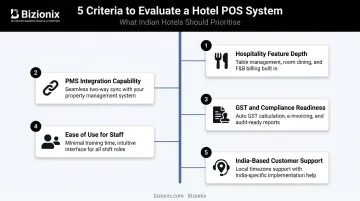
Systems were assessed across five dimensions:
- Hospitality-specific feature depth — folio posting, KOT management, table management, and room-charge billing
- PMS and third-party integration capability — real-time sync, not batch updates
- GST and Indian compliance readiness — split invoicing, e-invoicing, IRN generation
- Ease of use for high-turnover staff — critical for properties with frequent staff changeovers
- Quality of India-based customer support — local support is a practical necessity
A common mistake buyers make is choosing based solely on upfront price. The total cost of ownership — subscription fees, hardware, transaction costs, and time spent on manual workarounds when a system doesn't integrate properly — can run significantly higher than the sticker price suggests.
Non-negotiable criteria for Indian hotels:
- GST-split invoicing across room tariff, F&B, and ancillary services
- UPI and digital wallet payment support
- India-based customer support with reasonable response times
- Cloud architecture preferred — cloud accounts for 64.92% of hospitality PMS market share in 2025 per Mordor Intelligence, with on-premise deployments now a shrinking minority
That said, hotels with genuinely unreliable internet connectivity may still need an on-premise fallback — but for most properties, cloud is the default.
Conclusion
The right hotel POS system does more than process payments. It connects every guest touchpoint to a unified financial picture, catches revenue before it leaks, and gives management the outlet-level data needed to make pricing and staffing decisions with confidence.
When evaluating systems, prioritise integration depth over feature lists. A POS with 50 features but poor PMS sync will cost more in manual reconciliation time than it saves anywhere else.
Hotels looking for a unified platform can explore Bizionix, an ERP built specifically for Indian hospitality businesses. Its HotelEase module covers Billing & POS, Restaurant & Banquets management, and real-time financial reporting — without the SAP-level setup costs or implementation timelines that typically come with full-scale enterprise systems.
Frequently Asked Questions
What is the most popular hotel POS software?
Oracle MICROS Simphony dominates among large hotel chains and luxury properties globally. For mid-size Indian hotels, eZee BurrP! is widely adopted due to its India-built GST compliance and affordable pricing. Popularity varies by hotel size and operational complexity.
What is the difference between a hotel POS system and a PMS?
A PMS manages reservations, check-in/out, room inventory, and guest profiles. A POS handles on-property transactions at F&B outlets, spas, and retail. The two should be integrated so charges post automatically to guest folios and appear on a single checkout invoice.
How much does a hotel POS system cost in India?
Costs vary widely. Cloud-based systems like Hotelogix start at roughly ₹250–400 per room per month; eZee BurrP! uses requirement-based quote pricing. Enterprise systems like Oracle MICROS Simphony and IDS Next FortuneNEXT are custom-quoted, with hardware always priced separately.
Can a hotel POS system work offline?
Some cloud-based systems include offline modes that cache transactions locally and sync when connectivity is restored. Legacy on-premise systems work fully offline but require higher upfront investment and ongoing manual updates. Properties in low-connectivity areas should confirm offline capability before committing to any platform.
What integrations should a hotel POS system have?
Critical integrations include: PMS (for automatic folio posting), accounting or ERP software (for financial reporting and GST compliance), and payment gateways (for UPI, card, and digital wallet processing). Inventory management and CRM integrations add further operational value.
Is cloud-based POS better than on-premise for hotels?
For most Indian hotels, yes. Cloud-based POS offers lower upfront cost, automatic updates, remote dashboard access, and easier third-party integration. On-premise may suit properties with unreliable internet, but the total cost of ownership and update burden now clearly favour cloud.