This isn't a rare problem. SHRM research found that 73% of HR leaders say their work remains more administrative and process-focused than they'd like — and 83% reported lacking the right technology to change that.
An employee management system (EMS) directly addresses this bottleneck. This guide covers what an EMS is, the different types available, the must-have features to evaluate, the concrete benefits it delivers, and how to choose the right fit for your business.
Key Takeaways
- An EMS is a digital platform that centralises the full employee lifecycle — from hiring and attendance to payroll and performance — in one place
- Three system types cover different needs: HRIS handles core data and processes, HCM adds talent and compensation planning, and HRMS is the most comprehensive — combining both with payroll and time tracking
- Must-have features include a centralised employee database, time and attendance tracking, payroll management, performance management, and a self-service portal
- Primary benefits: reduced admin burden, fewer payroll errors, stronger compliance, better employee experience, and data-driven workforce decisions
What Is an Employee Management System?
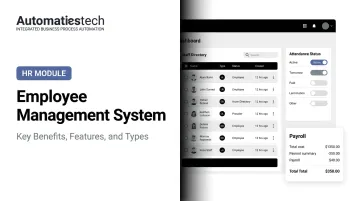
An employee management system is a digital platform that handles the full employee lifecycle — from recruitment and onboarding through daily attendance tracking, payroll processing, performance reviews, and eventually offboarding — all from a single interface.
Modern systems are cloud-based, so HR teams and employees can access relevant information in real time from any location — useful for businesses with distributed teams or multiple branches.
How an EMS Differs from Standalone HR Tools
A standalone payroll tool processes salaries. A standalone leave tracker logs time off. But neither talks to the other — which means someone manually reconciles the data before payroll runs, and errors creep in.
An EMS integrates these functions so data flows automatically:
- Attendance updates feed directly into payroll calculations
- Promotions trigger automatic updates to compensation, reporting lines, and access permissions
- No duplicate data entry, no out-of-sync records
Why It Matters as Headcount Grows
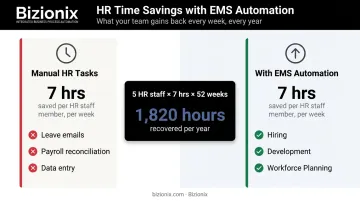
Manual HR processes don't scale. SHRM reports that automating administrative tasks saves HR staff over seven hours per week — time that can shift from data entry and email follow-ups to hiring, development, and workforce planning.
Indian MSMEs juggle statutory obligations — PF, ESI, TDS — on top of day-to-day HR work. Automating these tasks is what keeps compliance manageable without requiring a dedicated full-time hire.
Types of Employee Management Systems
The EMS market includes both comprehensive platforms and specialised tools. Choosing the wrong type often means paying for features you won't use, or missing capabilities you need.
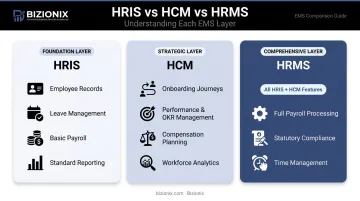
HRIS – Human Resource Information System
HRIS is the foundation-level system. It manages:
- Employee records and HR documentation
- Recruitment and basic applicant tracking
- Leave and absence management
- Benefits administration
- Core payroll processing
- Standard HR reporting
HRIS suits businesses that primarily need a reliable central database and process automation — without advanced talent analytics or strategic workforce planning tools.
HCM – Human Capital Management
HCM builds on HRIS by adding strategic people management capabilities:
- Structured employee onboarding journeys
- Performance and goal management (KPIs/OKRs)
- Compensation and benefits planning
- Workforce analytics and succession planning
HCM suits organisations ready to move beyond record-keeping into longer-term workforce strategy — linking performance data to compensation decisions and succession planning.
HRMS – Human Resource Management System
HRMS combines the full functionality of HRIS and HCM, then adds built-in payroll processing and project time management. Everything runs on one platform:
- Employee data and documentation
- Process automation and workflow management
- Workforce analytics and reporting
- Payroll with statutory compliance
- Internal communication tools
For growing Indian MSMEs, HRMS is typically the preferred choice — it handles PF, ESI, and TDS requirements alongside core HR, eliminating the need for multiple disconnected tools as headcount increases.
Specialised Tools
Beyond the core three, specific-function tools serve narrow needs:
- ATS (Applicant Tracking Systems) — recruitment and candidate pipeline management
- LMS (Learning Management Systems) — training and upskilling programmes
- TMS (Talent Management Systems) — career development and succession planning
Businesses with one specific, urgent need may start with a specialised tool. But most growing organisations eventually consolidate onto a unified HRMS — or a broader ERP platform — to avoid managing several disconnected systems simultaneously.
Must-Have Features of an Employee Management System
Centralised Employee Database
A good EMS serves as a single source of truth for all employee data — personal records, employment history, role information, and documents. When every department pulls from the same record, information stays consistent, audits become straightforward, and HR stops hunting through physical files or competing spreadsheets.
Time and Attendance Tracking
This feature automates work hour recording, shift scheduling, overtime tracking, and leave balances. Modern systems support multiple clock-in methods — biometric devices, mobile punch, web-based entry — and flag discrepancies automatically.
The payroll connection is where this really matters. EY's 2022 HR Processing Risk and Cost Survey found that time and attendance errors cost organisations USD 248,735 per 1,000 employees annually — with missing or incorrect time punches being the single most common payroll error type. Automated attendance that feeds directly into payroll eliminates this category of error almost entirely.
Payroll Management
Integrated payroll automates salary calculations, statutory deductions (PF, ESI, PT, TDS for Indian businesses), and payslip generation. The EY survey also found that the average payroll accuracy rate across organisations is just 80.15% — meaning roughly one in five payrolls contains errors, each costing an average of USD 291 to correct.
The key capability to look for is a system that stays current with Indian compliance rules — so contribution rates, salary thresholds, and filing requirements update automatically as regulations change.
Performance Management
Performance tools let managers set goals, run structured appraisal cycles, and collect feedback — then connect that data directly to compensation and promotion decisions. When employees can see the link between their records and outcomes, reviews feel less arbitrary.
A well-implemented performance module typically covers:
- Goal-setting frameworks (KPIs or OKRs) tied to role and department targets
- Scheduled appraisal cycles with structured rating workflows
- 360-degree or manager feedback collection
- Compensation and promotion recommendations linked to performance scores
Gallup's 2024 research found that 80% of employees who received meaningful feedback in the past week were fully engaged at work — a direct argument for formalising the feedback process rather than leaving it to ad hoc conversations.
Employee Self-Service Portal
Engagement improves when employees have control over their own information. Self-service portals give employees direct access to:
- View and download payslips
- Submit and track leave requests
- Check attendance records and balances
- Update personal details without raising an HR ticket
This cuts the volume of routine HR requests considerably — freeing HR teams to focus on hiring, compliance, and workforce planning instead of fielding basic queries.
For businesses with distributed teams or multiple branches — like many Indian MSMEs managing operations across locations — self-service portals remove geographical friction from routine HR interactions.
Key Benefits of an Employee Management System
Reduced Administrative Burden
Automating offer letter generation, leave approvals, payroll runs, and appraisal reminders removes the repetitive work that dominates HR calendars. The seven hours per week saved through HR automation (per SHRM's research) compounds quickly. Across a team of five HR staff, that's over 1,800 hours per year redirected from admin to actual people management.
Enhanced Data Accuracy
A unified system with automated validation eliminates manual reconciliation errors. When attendance data updates, payroll pulls it automatically. When an employee's role changes, all connected modules reflect it. Reports are always based on current information — not last week's export from a spreadsheet someone emailed around.
Stronger Compliance and Reduced Risk
For Indian businesses, statutory compliance isn't optional:
- PF/EPF: 12% employee + 12% employer contribution, with penal interest from 5-15% p.a. for delayed payments
- ESI: 0.75% employee + 3.25% employer contribution, effective from July 2019
- TDS on salary: Mandatory deduction under Section 192 of the Income Tax Act
- Professional Tax: State-specific obligations varying by Maharashtra, Karnataka, and other states
An EMS automates these calculations, generates the required filings, and flags upcoming deadlines. That removes the inadvertent violations that creep in when teams track obligations manually across spreadsheets and calendar reminders.
Better Employee Experience and Retention
Structured onboarding, transparent performance processes, and accurate, on-time pay all contribute to how employees feel about working somewhere. Brandon Hall Group's 2024 research found that organisations with high onboarding maturity were 103% more likely to see improvements in new-hire retention and employee engagement.
Payroll accuracy is equally critical. EY's survey found payroll error disputes contributed to increased employee turnover in 35% of cases. Getting pay right, on time, is a basic expectation — and one that manual processes often fail to meet.
Data-Driven HR Decision-Making
An EMS gives HR leaders real-time analytics on absenteeism trends, attrition patterns, headcount by department, and compensation benchmarks. McKinsey's people analytics research points to measurable outcomes for organisations that use workforce data effectively:
- 80% increase in recruiting efficiency
- 25% rise in business productivity
- 50% decrease in attrition rates
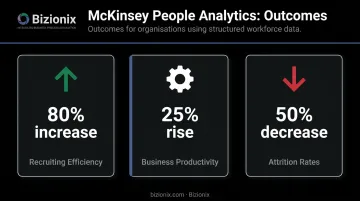
These results come from having clean, structured data in one place. Pulling numbers from three different systems and reconciling them manually produces delays, gaps, and decisions made on stale information.
How to Choose the Right Employee Management System
Start with Your Actual Pain Points
Before evaluating tools, list your most pressing problems. A 20-person business with one location and consistent payroll has different needs than a 200-person organisation across multiple departments and cities.
Common pain points that drive EMS selection:
- Payroll errors and manual reconciliation
- No visibility into attendance or leave balances
- Compliance anxiety around PF, ESI, and TDS filings
- HR time consumed by routine requests
- Inconsistent data across departments
The type of system you choose — HRIS vs. HRMS — should map directly to these priorities, not to feature lists.
Evaluate Integration and Scalability
The right EMS should connect with your existing tools (accounting software, project management platforms, or ERP systems) and handle growth without requiring a migration every few years.
For growing Indian MSMEs juggling finance, inventory, and GST compliance across separate tools, a unified ERP platform with an integrated HRMS module often delivers more value than adding another standalone tool.
Bizionix, for example, integrates HRMS and payroll within a cloud ERP suite. Attendance data, payroll processing, and financial reporting all operate from the same database — no manual transfers between systems.
Assess Ease of Adoption and Total Cost
Integration and scalability matter — but so does whether your team will actually use the system. Before committing:
- Request a demo focused on your specific workflows, not a generic product tour
- Evaluate vendor support — response times, training materials, and implementation help
- Understand the pricing model — per-user, flat annual fee, or modular pricing all have different cost implications as you scale
- Check onboarding support — particularly for statutory compliance setup, where mistakes have real financial consequences
Frequently Asked Questions
What is the difference between HRIS, HRMS, and HCM?
HRIS is the base layer, covering employee data, leave, basic payroll, and core HR processes. HCM expands on this with talent management, performance tools, and workforce analytics. HRMS is the most comprehensive option, combining both with full payroll processing and time management in one platform.
Is an employee management system suitable for small businesses?
Yes. Even small businesses benefit from centralising employee records and automating payroll and attendance. Many modern systems — including those bundled within affordable ERP platforms — allow businesses to start with core features and scale up as headcount and complexity grow.
How does an employee management system support statutory compliance in India?
A well-designed EMS automates PF, ESI, PT, and TDS calculations based on current rates, generates required compliance reports, and alerts teams to filing deadlines — significantly reducing the risk of errors and penalties that arise from tracking these obligations manually.
Can an employee management system integrate with other business software?
Most modern EMS platforms offer integration with payroll tools, accounting software, and ERP systems. Choosing a unified platform where HR is already built alongside finance and operations modules eliminates the need for third-party integrations entirely.
What is the difference between an employee management system and an ERP?
An EMS covers HR processes: attendance, payroll, and performance management. An ERP is broader, managing finance, inventory, sales, and HR in one platform. For growing businesses, an ERP with an integrated HR module is often more efficient than running a standalone EMS alongside separate finance and inventory tools.