Manual invoice processing makes this worse. When AP staff manually retrieve purchase orders, cross-reference line items, and chase delivery confirmations, errors accumulate. Slow processing means missed early-payment discounts. Unchecked discrepancies lead to overpayments. Research from Ardent Partners shows typical AP teams take 17.4 days to process an invoice — compared to just 3.1 days for best-in-class teams.
Invoice matching software closes that gap. Yet many finance teams treat it as a checkbox feature rather than understanding how it actually enforces accuracy and speed at every stage of the payment cycle. That misunderstanding is expensive.
Key Takeaways
- Invoice matching software automatically compares supplier invoices against purchase orders and delivery receipts before payment is released
- It supports 2-way, 3-way, and 4-way matching — each adding more verification layers for higher-risk purchases
- OCR and AI extract invoice data, flag mismatches, and route exceptions without manual intervention
- AP teams using automation report up to 82% faster invoice processing and exception rates 59% lower than manual workflows, according to industry benchmarks
- Delivers the highest ROI for businesses managing invoices across multiple vendors, locations, or GST-registered entities
What Is Invoice Matching Software?
Invoice matching is the accounts payable process of verifying that a supplier's invoice aligns with the corresponding purchase order (PO) and/or goods delivery receipt before payment is released. Invoice matching software automates this verification digitally — replacing the manual document-chasing that slows down most AP teams.
Historically, AP staff manually retrieved POs, compared line items one by one, checked quantities, and confirmed prices. At low volumes, this is manageable. Once invoice volumes scale, the process breaks down: errors multiply, approvals slow, and payment disputes with vendors become routine.
Invoice matching software handles a specific function: the verification and validation step within accounts payable. It's distinct from general invoicing or billing tools and is typically integrated into a broader ERP or AP automation platform.
The Three Levels of Matching
The software supports three standard verification levels, each adding more control:
| Matching Type | Documents Compared | Typical Use Case |
|---|---|---|
| 2-Way Matching | Invoice vs. Purchase Order | Service-based or recurring purchases where physical delivery confirmation isn't needed |
| 3-Way Matching | Invoice + PO + Goods Receipt Note (GRN) | Physical goods procurement — confirms delivery before payment is released |
| 4-Way Matching | Invoice + PO + GRN + Inspection/Acceptance Report | Pharma, auto components, construction — quality sign-off required before payment |
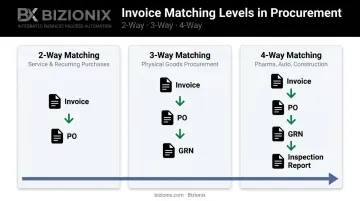
These levels function as internal financial controls built into the payment workflow. Automating them lets growing businesses maintain audit-ready accuracy without adding AP headcount as invoice volumes rise.
How Invoice Matching Software Works
The software operates as a defined sequence of stages, each adding accuracy and control from invoice receipt through payment approval.
Stage 1: Invoice Receipt and Digitisation
When a supplier invoice arrives — by email (PDF), EDI, or paper — the software digitises and captures it using Optical Character Recognition (OCR) to convert unstructured documents into machine-readable data.
Digital invoices are processed fully automatically. Paper invoices need scanning before OCR can process them. The quality of data captured at this stage determines how accurate all downstream matching will be — poor capture creates errors that compound through every subsequent step.
Stage 2: Data Extraction and Matching
This is where the core verification happens. The software extracts key fields from the invoice:
- Supplier name and ID
- Invoice number and date
- Line items, quantities, and unit prices
- Tax amounts and totals
These are cross-referenced against the corresponding PO and/or GRN pulled from the ERP or procurement system.
Tolerance levels are configurable here. A business might auto-approve invoices with a price variance under 1–2%, while larger discrepancies trigger an exception. This prevents minor rounding differences or currency variations from creating bottlenecks. According to the Hackett Group, AP automation adopters achieve 60% average touchless invoice processing and 59% average AP cycle-time improvement — driven largely by this automated matching stage.
Stage 3: Exception Handling
When a mismatch is detected — invoice quantity differs from the GRN, price doesn't match the PO — the software flags it as an exception and routes it automatically to the relevant stakeholder with full context attached. There's no manual triage, and no paper trails moving between desks.
This stage is where manual processes fail most often. Unresolved exceptions cause payment delays, damage vendor relationships, and cost teams early-payment discounts. Automated routing with audit trails means exceptions are resolved faster, with clear accountability at every step.
Stage 4: Approval, Posting, and Payment
Invoices that clear all matching checks are automatically approved and posted to the accounting system. A complete audit trail — covering every match, exception, and decision — is maintained for compliance and reporting purposes.
For businesses managing GST-compliant invoices in India, this audit trail also supports GST reconciliation and audit readiness. Each transaction is recorded with validated:
- GSTIN and supplier details
- HSN codes and line-item tax amounts
- Total tax values and invoice references
How Invoice Matching Software Improves Accuracy and Speed
The accuracy improvement comes from a simple shift: removing human judgment from routine validation. The software applies identical matching rules to every invoice, every time — no fatigue, no oversight, no inconsistency.
Fewer Errors, Faster Approvals
Ardent Partners' AP benchmarking data shows best-in-class AP teams achieve:
- 82% faster invoice processing times than peers
- 78% lower per-invoice processing costs
- 9% exception rate vs. 22% industry average
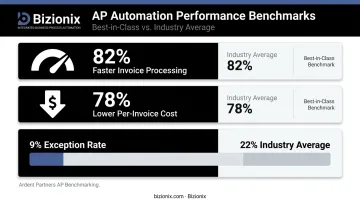
These aren't marginal gains. They reflect what happens when consistent rules replace inconsistent human review.
Fraud Detection Built Into Every Transaction
Invoice matching software functions as an automated internal audit at every payment. It flags:
- Duplicate invoice numbers submitted by the same vendor
- Invoices without a valid PO reference
- Mismatched vendor IDs or bank details
- Inflated quantities compared to the GRN
This matters because 76% of organizations experienced attempted or actual payments fraud in 2025, according to the AFP Payments Fraud and Control Survey. Catching these issues before they reach the payment queue — rather than discovering them during a quarterly audit — is the practical value of automated matching.
Exception Rates Improve Over Time
AI-powered matching learns from historical patterns. If a particular vendor consistently rounds differently or uses a non-standard invoice format, the system builds that recognition into future processing. This reduces false flags over time and increases straight-through processing rates — meaning fewer exceptions to manually resolve with each invoice cycle.
Downstream Business Impact
Better accuracy and speed create compounding benefits:
- AP teams spend less time on manual reconciliation
- Payment terms are met more reliably, reducing vendor friction
- Early-payment discounts become achievable at scale
- Finance leaders gain real-time visibility into payables status
For Indian MSMEs, realizing these benefits depends on having systems that connect AP workflows to GST compliance from the start. Bizionix addresses this directly: its ERP platform integrates purchase management with GRN tracking, GST-ready accounting, and direct API connectivity with the GST e-Invoice system — so matching, compliance, and payment visibility all operate from one platform rather than across disconnected tools.
Where Invoice Matching Software Is Used
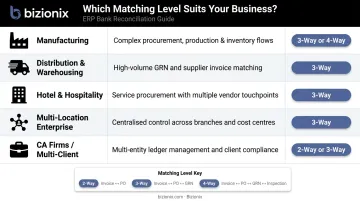
Not every business needs the same matching approach. The right level depends on purchasing structure, goods type, and compliance requirements.
Business Types That Benefit Most
- Manufacturing companies — 3-way or 4-way matching protects against delivery shortfalls and quality failures across multiple suppliers
- Distribution and warehouse operations — high invoice volumes across multiple vendors make manual processing a serious bottleneck
- Hotel and hospitality groups — F&B, housekeeping, and facilities procurement generate concurrent supplier invoices that need structured reconciliation
- Multi-location enterprises — consistent matching rules across branches prevent discrepancies in AP reporting
- CA firms overseeing payables for multiple client entities from a single access point
Matching Level by Business Type
| Business Type | Recommended Matching | Reason |
|---|---|---|
| Service or subscription business | 2-Way | No physical delivery to verify |
| Distributor or retailer | 3-Way | Delivery confirmation before payment |
| Manufacturer | 3-Way or 4-Way | Delivery and quality checks required |
| Pharma / construction | 4-Way | Regulatory compliance on acceptance |
Invoice matching software delivers maximum value when a business has structured purchasing (POs issued before delivery), physical goods procurement, or regulatory requirements around payment authorisation. For these scenarios, matching works best as part of an ERP-integrated AP workflow, where it can draw on live procurement and inventory data rather than operating in isolation.
For Indian MSMEs, the GST e-invoice mandate — now covering businesses with aggregate turnover of ₹5 crore and above (from 1 August 2023) — means the digital invoice infrastructure is already in place. Connecting that to a structured matching workflow is the practical next step.
Conclusion
Invoice matching software automates a verification process that every business with vendor payments must perform — whether that's 2-way, 3-way, or 4-way matching. The software makes that process faster, more consistent, and more controlled than manual methods allow.
Finance leaders who understand the full workflow are better positioned to:
- Configure the right level of automation for their AP volume
- Set tolerance thresholds that balance speed with accuracy
- Measure AP performance against meaningful benchmarks
Industry benchmarks put best-in-class AP teams at 3.1 days per invoice, compared to 17 days for manual processes — a gap driven almost entirely by automation. For Indian MSMEs managing GST compliance alongside routine payables, closing that gap means fewer vendor disputes, cleaner audit trails, and faster payment cycles.
Frequently Asked Questions
What is the difference between 2-way, 3-way, and 4-way invoice matching?
2-way matching compares the invoice against the purchase order only. 3-way adds the goods receipt note to confirm delivery occurred. 4-way further adds an inspection or acceptance document — used in sectors where quality verification is required before payment is authorised.
What happens when an invoice fails the matching process?
The software flags it as an exception and routes it automatically to the relevant stakeholder (procurement manager, vendor, or department head) with full context included. Payment is held until the discrepancy is reviewed and resolved.
How does invoice matching software detect duplicate or fraudulent invoices?
The system compares each incoming invoice against existing AP ledger records using fields like invoice number, supplier ID, amount, and date. Any invoice matching a previous entry or lacking a valid PO reference is flagged for manual review before payment proceeds.
Can invoice matching software handle GST-compliant invoices in India?
Yes. Invoice matching tools integrated with GST-ready ERP platforms can validate GST fields including GSTIN, HSN codes, tax amounts, and e-invoice data (IRN and QR code), supporting full compliance before payment is released.
Is invoice matching software suitable for small and mid-sized businesses?
Yes. Even moderate invoice volumes strain small AP teams. Cloud-based ERP platforms with built-in invoice matching, like Bizionix, give MSMEs access to the same controls larger enterprises rely on — without needing a dedicated AP headcount.
What documents are typically compared during the invoice matching process?
The core documents are the supplier invoice, purchase order (PO), and goods receipt note (GRN). In 4-way matching, an inspection or acceptance report is added. The software cross-checks all three (or four) documents to confirm that what was ordered, delivered, and billed aligns before payment is released.